
Miami is often described through its beaches, nightlife and waterfront lifestyle, yet one of the most distinctive ways to understand the city is through its architecture, where nearly a century of design tells the story of how Miami evolved from a tropical resort destination into one of the most visually recognizable cities in the world.
Nowhere is that story more vivid than in Miami Beach, where pastel façades, geometric ornamentation, rounded corners, nautical details and luminous neon have become inseparable from the city’s identity. At the same time, Miami’s architectural character extends well beyond Art Deco, incorporating Mediterranean Revival, Miami Modern and bold contemporary residential design into a landscape that continues to reinvent itself while remaining unmistakably connected to its past.
For travelers who appreciate architecture, design and history, exploring Miami through its buildings offers a deeper way to experience the city, revealing how climate, culture, optimism and international influence have shaped everything from historic hotels along Ocean Drive to the modern villas that define many of Miami’s most desirable neighborhoods today.
Miami Beach and the Rise of Art Deco
Art Deco emerged internationally during the early twentieth century and gained widespread recognition after the 1925 International Exposition of Modern Decorative and Industrial Arts in Paris, where a new visual language of geometric form, decorative detail and modern materials captured the optimism of an era looking toward the future.
Miami Beach embraced the style during the 1930s, particularly as the city rebuilt and expanded after the devastating hurricane of 1926, and what developed here was not simply a copy of European Art Deco but a distinctly tropical interpretation adapted to the light, climate and personality of South Florida.
Today, Miami Beach is home to the world’s largest concentration of Art Deco architecture, with more than 800 historic buildings associated with the movement and related styles, many of them concentrated along Ocean Drive, Collins Avenue and Washington Avenue between approximately 5th and 23rd Streets.
The result is a district that feels less like a preserved collection of isolated landmarks and more like a living architectural environment, where restaurants, hotels, shops and residences continue to operate within buildings that helped define Miami Beach nearly a century ago.
The Signature Language of Miami Art Deco
The beauty of Miami Art Deco lies in its ability to combine discipline with playfulness, using symmetry, clean lines and geometric forms while embracing color, tropical motifs and decorative details that give the buildings an unmistakable sense of personality.
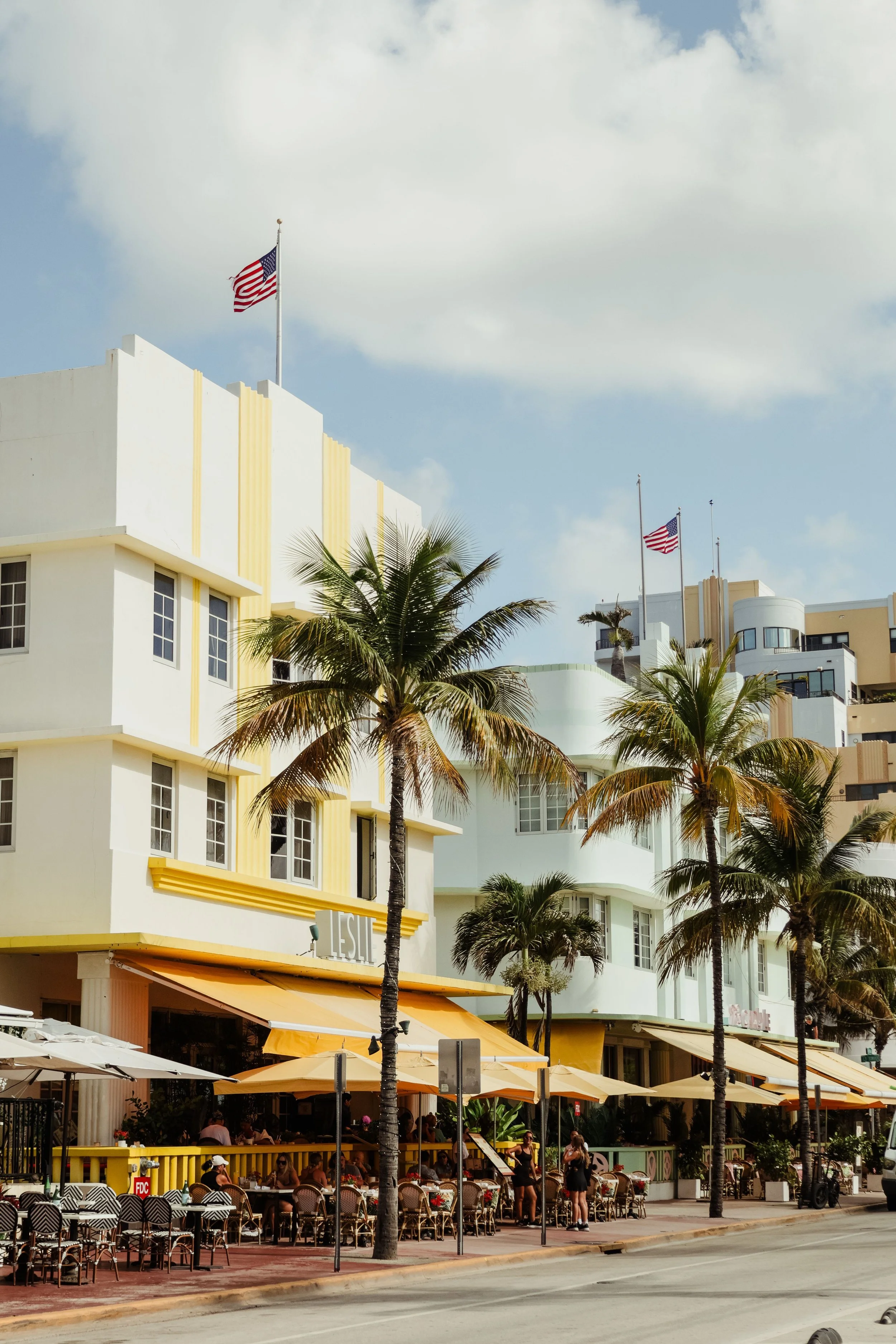
Pastel tones in pink, blue, yellow and green are among the most recognizable elements, particularly when combined with rounded corners, horizontal “eyebrows” above windows, glass blocks, terrazzo floors, chrome accents and neon signage.
Many façades incorporate stylized sunbursts, chevrons, zigzags and nautical details inspired by ships and ocean liners, which reflected the fascination with speed, travel and modernity that defined the period.
Miami Beach also developed its own variation often referred to as Tropical Deco, in which traditional Art Deco forms were softened and adapted to the subtropical environment through brighter colors, floral reliefs and shading devices that responded directly to the intensity of the Florida sun.
This combination of ornamentation and climate-sensitive design helped create an architectural language that was both glamorous and practical, allowing the buildings to feel modern while remaining distinctly rooted in their surroundings.
Ocean Drive as an Open-Air Architectural Gallery
For visitors interested in experiencing Art Deco firsthand, Ocean Drive remains one of the most rewarding places to begin because the concentration of historic façades allows the design vocabulary of the era to be appreciated almost block by block.
Buildings such as the Colony Hotel, the former Park Central and the Leslie Hotel illustrate how symmetry, vertical emphasis, curved lines and decorative elements were used to create buildings that felt dramatic despite relatively modest proportions.
During the day, the soft pastel colors and shadow lines reveal the geometry of the architecture, while at night, neon lighting transforms many of the same façades into something more theatrical, reinforcing the connection between Art Deco and Miami Beach’s long-standing reputation for glamour.
Walking rather than driving is the best way to experience the district, particularly because the scale of the buildings, storefront details and decorative motifs become much easier to appreciate at street level.
The Miami Design Preservation League also offers walking tours that provide additional historical and architectural context for visitors who want to better understand how these structures were designed, preserved and incorporated into modern Miami Beach.
Preservation Helped Define Modern Miami Beach
The Art Deco District feels inevitable today, yet many of the buildings that now define Miami Beach were once threatened with demolition as tastes changed and older hotels fell into disrepair after World War II.
During the 1970s, preservationist Barbara Baer Capitman and other advocates began organizing efforts to protect the architectural character of South Beach, ultimately leading to the creation of the Miami Design Preservation League.
Those efforts culminated in 1979 when the Miami Beach Architectural District became the first urban twentieth-century historic district in the United States to be listed on the National Register of Historic Places.
The preservation movement did more than save individual buildings; it helped transform architectural heritage into one of Miami Beach’s defining cultural assets, proving that historic character and modern luxury could coexist rather than compete with one another.
Beyond Art Deco: Mediterranean Revival
Although Art Deco may be the style most closely associated with Miami Beach, it represents only one chapter in the region’s architectural history.
Mediterranean Revival architecture became highly influential throughout South Florida during the early twentieth century, drawing inspiration from Spanish, Italian and Mediterranean traditions and incorporating arches, courtyards, stucco walls, clay tile roofs and decorative stonework.
The style remains particularly visible in Coral Gables and parts of Miami Beach, where its romantic proportions and shaded outdoor spaces feel naturally suited to the tropical climate.
These buildings introduced another interpretation of luxury, one rooted in gardens, courtyards and old-world detail rather than the streamlined modernity of Art Deco, yet both approaches contributed to the architectural identity that travelers associate with Miami today.
Miami Modern and the Postwar Evolution of Design
Following World War II, Miami’s architectural language continued to evolve through Miami Modern, commonly known as MiMo, which introduced a more futuristic approach to design while retaining the sense of glamour associated with the city’s earlier buildings.
MiMo architecture often featured dramatic rooflines, sunshades, mosaic walls, sweeping curves and large areas of glass, combining modernist principles with decorative flourishes and tropical responsiveness.
Rather than rejecting Miami’s earlier architectural traditions entirely, MiMo continued the city’s habit of adapting international design movements to local climate and lifestyle, producing buildings that felt optimistic, theatrical and unmistakably South Floridian.
The progression from Mediterranean Revival to Art Deco and MiMo makes Miami especially rewarding for architecture enthusiasts because several distinct design eras can be experienced within a relatively small geographic area.
Contemporary Miami Architecture
Modern Miami has continued this tradition of architectural experimentation, particularly in residential design, where expansive glass, open-plan interiors, dramatic overhangs and seamless transitions between indoor and outdoor living have become defining characteristics.
Contemporary villas frequently emphasize natural light, tropical landscaping and views of water or gardens, while kitchens, living spaces and terraces are often designed to flow together rather than being treated as separate environments.
This architectural approach reflects the way luxury is experienced in South Florida today, where the most desirable homes are designed not simply to be admired but to support a lifestyle centered around entertaining, swimming, dining outside and moving effortlessly between interior and exterior spaces.
In this sense, contemporary Miami architecture may look very different from Art Deco, yet the two share an important principle: both respond to the city’s climate, personality and enduring desire to make design feel expressive rather than anonymous.
Featured Stay: Villa Amelia
For travelers interested in experiencing Miami’s contemporary architectural language from within, Villa Amelia by Avali Villas provides a compelling modern counterpoint to the historic architecture found across Miami Beach.
Located in the heart of the Miami Design District, Villa Amelia sits within one of the city’s most visually sophisticated neighborhoods, surrounded by contemporary galleries, luxury fashion houses, acclaimed restaurants and cutting-edge design, allowing guests to move naturally between architecture, art and modern Miami culture.
The residence occupies an approximately 8,500-square-foot property and offers four bedrooms with accommodations for up to 12 guests, while roughly 3,048 square feet of interior living space has been organized around a bright open-concept layout that emphasizes natural light and contemporary finishes.
Expansive floor-to-ceiling impact glass creates a fluid connection between the interior and the surrounding tropical landscape, allowing the living areas to open naturally toward a covered terrace and private spa-style pool, an architectural approach that reflects the importance of indoor-outdoor living in contemporary Miami design.
The chef-inspired kitchen features Sub-Zero, Wolf and Bosch appliances alongside custom cabinetry and sleek detailing, while the outdoor spaces are framed by tropical landscaping that creates a sense of privacy despite the villa’s central urban location.
Perhaps most appealing for design-conscious travelers is the villa’s relationship with its surroundings, because guests can walk to galleries, boutiques, restaurants and cafés throughout the Design District before returning to a residence that expresses many of the same contemporary principles of openness, light and refined materiality.
With rates currently starting from approximately $1,200 per night, Villa Amelia offers an opportunity to experience modern Miami architecture not simply as something to observe, but as a setting to inhabit throughout the stay.
Explore the Miami Design District Through Architecture
The Miami Design District provides one of the best places to see how architecture continues to shape the identity of the city, particularly because many buildings in the neighborhood have been designed to function as visual experiences rather than simply as places for retail or dining.
Luxury boutiques, public art, sculptural façades and contemporary installations sit side by side, making the streets themselves part of the attraction and creating an environment where architecture, fashion and art overlap naturally.
For guests staying at Villa Amelia, that proximity allows the neighborhood to be explored slowly rather than as a quick shopping stop, with enough time for galleries, lunch, architecture and an evening meal before returning home on foot.
This sense of immersion is especially appealing for travelers who view design as part of the destination rather than merely as a backdrop to it.
From Ocean Drive to Contemporary Villas
One of the pleasures of exploring Miami through architecture is discovering how dramatically the city can change within a short distance.
A morning on Ocean Drive can be spent among pastel Art Deco hotels built during the 1930s, while an afternoon in the Design District can reveal contemporary architecture defined by glass, sculptural façades and innovative materials.
Another day might lead to the Mediterranean Revival streets of Coral Gables or the postwar MiMo landmarks farther north along Miami Beach, allowing visitors to experience several generations of design without leaving South Florida.
This diversity gives Miami an architectural richness that extends well beyond any single style, even though Art Deco remains the visual language most closely associated with the city around the world.
Why Art Deco Still Feels Modern
Part of the enduring appeal of Art Deco is that the style was designed around optimism, movement and the excitement of modern life, qualities that continue to feel surprisingly appropriate in Miami nearly a century later.
The geometric lines remain visually strong, the colors feel naturally suited to the subtropical light and the relationship between decoration and functionality gives the buildings a sense of personality that many contemporary structures struggle to replicate.
The style also demonstrates how architecture can become part of a destination’s identity, transforming ordinary hotels and commercial buildings into landmarks that people travel specifically to see.
Miami Beach’s preservation of its Art Deco heritage has therefore done more than protect historic structures; it has preserved an entire visual language that continues to influence photography, fashion, hospitality, interior design and the broader image of Miami around the world.
Experience Miami Through Design
Miami rewards travelers who look beyond its most familiar attractions because its architecture reveals a city shaped by reinvention, international influence and an enduring willingness to embrace bold ideas.
Art Deco remains the most iconic expression of that history, with its pastel façades, geometric ornamentation and tropical interpretation creating one of the world’s most recognizable architectural districts, yet Mediterranean Revival, MiMo and contemporary design each contribute another layer to the story.
For travelers who appreciate architecture and interiors, staying in a private residence can make that experience even more immersive by allowing modern Miami design to become part of everyday life rather than simply something viewed during sightseeing.
Avali Villas offers a curated collection of luxury homes throughout Miami and South Florida, including contemporary residences such as Villa Amelia, along with personalized concierge services that can help guests experience the city according to their interests.
From the neon glow of Ocean Drive to the glass walls and tropical landscaping of a modern private villa, Miami’s architecture is not simply something that surrounds the city; it is one of the most compelling ways to understand what makes Miami unlike anywhere else.